
How much residual waste do you still create before the printer even starts running? The answer often lies in the preparation: nesting. This involves positioning the designs to be printed in such a way that a minimal amount of cutting waste remains. In this article, we describe how order timing, batching, and nesting can directly benefit both your wallet and the planet.
Time as a Critical Resource
Sustainability in Large Format Printing is not only about materials or inks. The way orders arrive at the print company largely determines substrate consumption.
When files are submitted with a request for rapid delivery, the operator must print the requested substrate with the jobs available at that moment. As a result, areas remain unused, and waste is generated that could easily have been avoided with better timing.
In addition, a growing stock of leftover strips in various sizes is created. In an environment where many different materials are in circulation, this stock is difficult to use profitably.
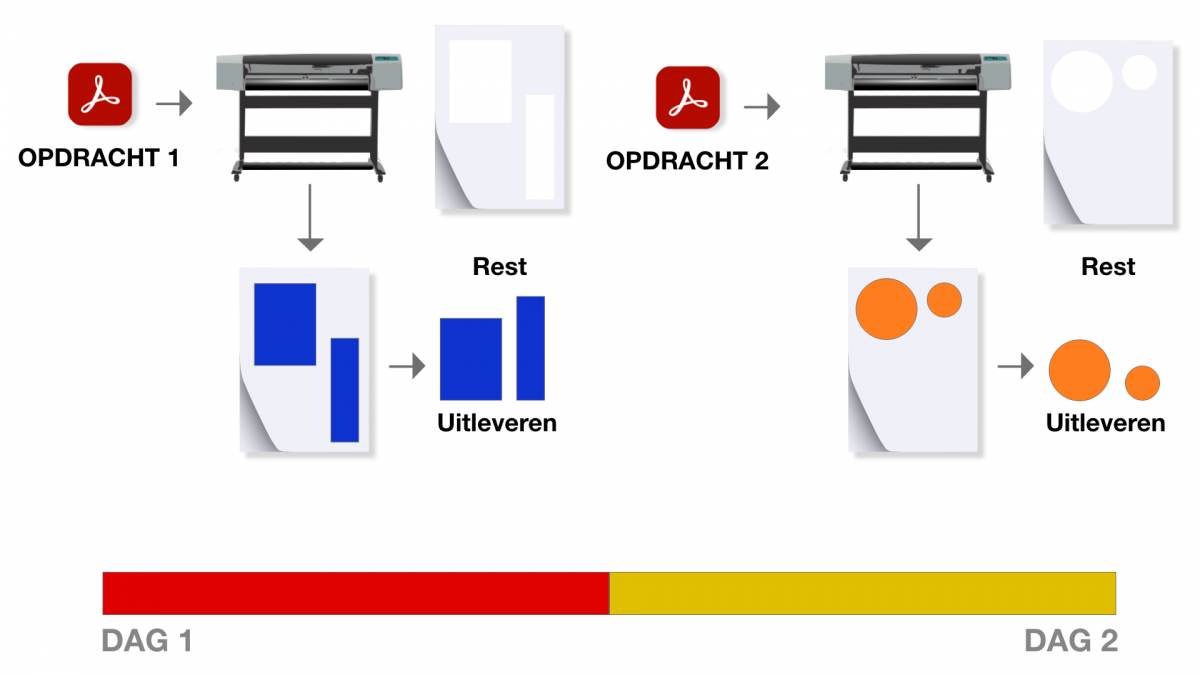
Fig. 1. Sequential processing of incoming orders: a large volume of unprinted substrate remains.
Fig. 2. When more time is available, nesting can be used: multiple jobs are placed on the same substrate, resulting in less waste.
If there is room to “save up” incoming jobs — meaning they do not have to be delivered immediately — the available time can be used for sustainable optimization. Different jobs can be grouped to minimize material loss: a gain for both your wallet and the planet.
Advice for Your Ordering Process
Communicate to customers that timely submission makes a concrete contribution to sustainable production. By working with fixed cut-off times — for example, all files submitted before 12:00 noon — you create sufficient volume for an efficient afternoon batch.
Timely submission creates bundling, bundling creates efficiency, and efficiency reduces material consumption.
Technical Focus: The Difference Between Ganging and Nesting
Ganging
Ganging groups different orders on one sheet based on the bounding box.
This works very well for rectangular products such as panels, flyers, or cards.
For organic or complex shapes, the corners around the shape remain unused.
True-shape nesting
True-shape nesting takes the actual contour into account and places shapes as closely together as possible, including rotation.
This is crucial for stickers, displays, routed letters, and any application where the shape is not rectangular.
Impact on material yield:
For complex shapes, ganging can cause up to 40 percent waste. True-shape nesting often reduces this to less than 15 percent.
Conclusion
Sustainable production requires both technological optimization and behavioural discipline.
Nesting software only delivers its maximum benefit when files are submitted on time.
By applying clear deadlines and actively informing customers, you strengthen both efficiency and your sustainability impact.
