
Sustainability is becoming a key priority in the print and signage industry. One of the major challenges in achieving circularity is the removal of inks from substrates, a process known as deinking. This step is essential to enable recycling and reuse of materials, reducing environmental impact and waste. While deinking technologies are well established in packaging, their application in large-format printing and signage is still in its early stages. This article provides an overview of recent commercial developments and highlights Centexbel’s research efforts to develop practical solutions for this sector.
Commercial developments
In recent years, the packaging industry has taken the lead in developing technologies that enable deinking and improve recyclability. These innovations, while primarily designed for packaging, provide valuable insights for the large-format print and signage sector.
One notable example is Arkema, which has introduced advanced solutions for UV-cured systems. Their approach focuses on creating debondable UV primers and modifying ink formulations to allow easier removal during recycling. The primers act as a sacrificial layer, ensuring strong adhesion during printing but enabling controlled delamination when exposed to specific recycling conditions. This technology aligns with European sustainability targets and demonstrates how chemical design can facilitate circularity.
Similarly, Siegwerk has developed a range of de-inkable coatings and primers that work within standard industrial recycling processes. Their solutions include alkali-strippable primers combined with UV inks, which have been certified for PET recycling. More recently, Siegwerk launched a UV-flexo deinking primer for labels, enabling complete ink removal under hot-wash conditions without compromising the quality of the recovered material. These developments show how ink and coating systems can be engineered to integrate seamlessly into existing recycling workflows.
Although these technologies are currently focused on packaging, they highlight principles that could be adapted for large-format applications. UV-curable systems are widely used in signage, and the concept of sacrificial primers or strippable coatings could be applied to substrates such as PVC boards, polypropylene sheets, and composite panels. By leveraging these design strategies, the signage industry can move toward solutions that make deinking practical and cost-effective, supporting broader sustainability goals.
Centexbel Developments
Centexbel has been actively investigating solvent-based deinking methods for large-format prints on a variety of substrates. The goal of these experiments is to identify practical approaches that enable ink removal and improve the recyclability of commonly used signage materials. The results so far are encouraging and demonstrate that deinking is achievable under controlled conditions.
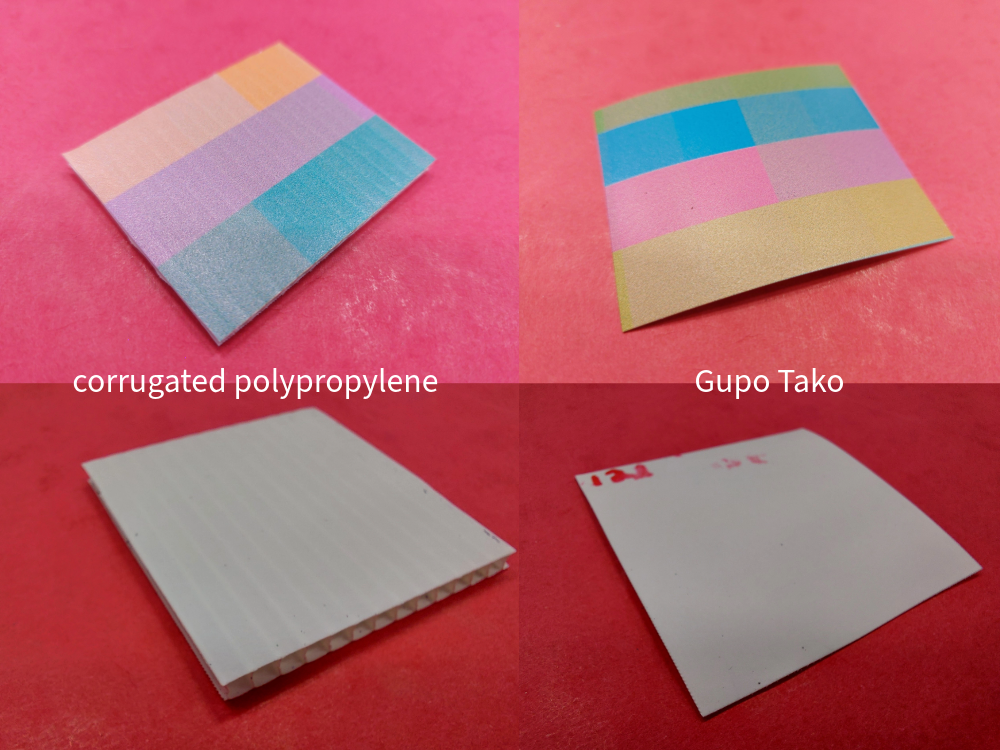
For example, prints on Gupo Tako substrates can be easily removed after soaking for five minutes in anisole. The ink loosens quickly, and with minimal rubbing, the surface becomes clean. Similarly, prints on polypropylene-based channel boards respond well to n-butyl acetate, with complete ink removal possible after one hour of soaking. UVgel prints, which are widely used in large-format applications, can also be removed from certain substrates using appropriate solvents.
More challenging substrates such as Dibond and Forex require additional effort. In these cases, a combination of abrasion and chemical treatment is necessary. Using solvents or specific degreasers in combination with mechanical action allows the ink to be detached from the surface, although the process is more labor-intensive compared to other materials.
These findings confirm that solvent-based deinking is a viable option for the large-format print and sign sector. By tailoring the choice of solvent and process to the substrate type, it is possible to significantly improve material recovery and support the industry’s transition toward circularity.
Conclusion
Commercial solutions for deinking currently focus on packaging, but Centexbel’s research shows that solvent-based techniques can be adapted for large-format signage. By tailoring processes to different substrates and combining chemical and mechanical methods, the industry can move closer to circularity and meet sustainability goals.
