
How do we work together toward a circular future?
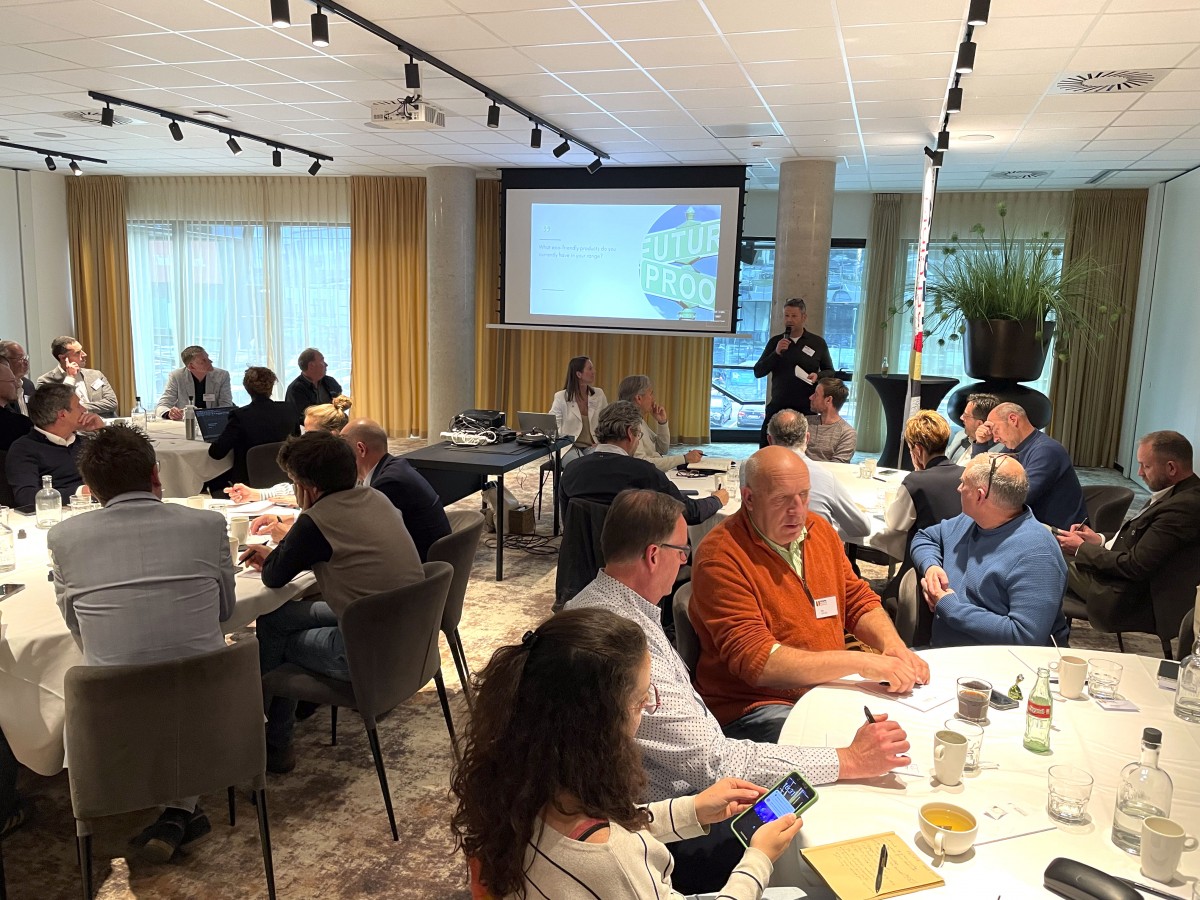
This was the central question at the ECO-forward event held on April 24. Initiator Jean Van Houtryve (VISIX), together with FESPA Belgium (Els Vansteenkiste) and CENTEXBEL & VIGC (Grace sustainability project), explored solutions for increasing circularity in printed textiles and printed panels. This was done through an interesting format: four tables were set up, each consisting of a printing company, a recycling company, a customer, and a sector organization. Each table deliberated on the same questionnaire concerning sustainability, after which their feedback was shared with the entire group.
Picture on the right: Jean Van Houtryve (VISIX) opens the ECO-forward roundtable discussions.
Downloads
Legislation
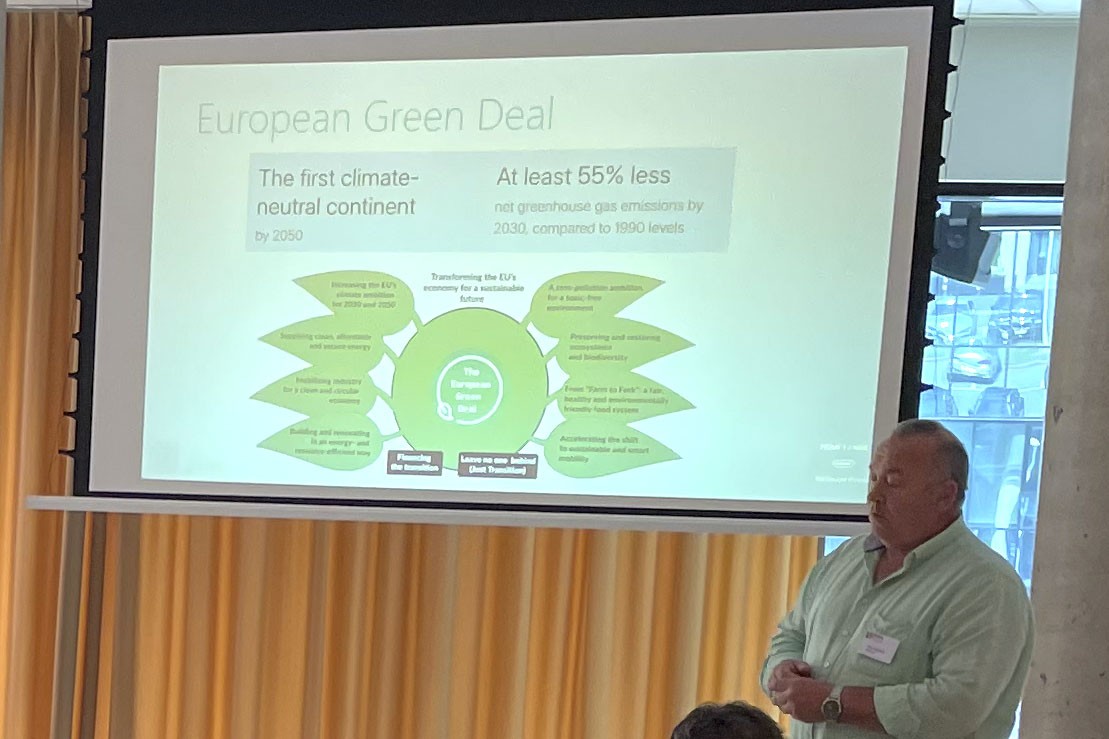
First, Wim Grymonprez, Manager of New Business Developments Plastics at CENTEXBEL, gave a substantive presentation on sustainability legislation to outline the discussion framework. The starting point, of course, is the European Green Deal. It remains essential that we Europeans believe in this approach and that the print production chain continues to follow the set path.
To motivate the industry toward greater sustainability, European countries have already translated the underlying principles into national legislation. For example, in Belgium, Valipack offers a bonus of €100 per ton of industrial packaging material that contains at least 30% Post-Consumer Recycled (PCR) material. High on the agenda for companies today are CO₂ reduction, energy efficiency (especially drying and curing of ink), and the use of sustainable materials (recycled or “bio”). Wim also shared interesting figures concerning recycled paper:
1 ton of recycled paper saves:
- 17 trees
- 1,440 liters of oil
- 2.3 m³ of landfill space
- 4,000 kW of energy
- 26,000 liters of water
Pictures on the right:
Fig. 2. Wim Grymonprez (CENTEXBEL) opens the afternoon with insights into developments in sustainability legislation.
Fig. 3. Key message: the principles of the European Green Deal!

A Level Playing Field
A level playing field for sustainable print production may seem obvious, yet it remains a clear concern among participants. A legal framework is needed, with caution against overregulation. Laws alone are not enough: transparent, standardized (calculation) methods and definitions are essential for correct implementation. Penalties or additional taxes for failing to meet the 30% recycled content requirement should not be up for debate—good behavior must be rewarded.
Geopolitics must also be considered. China currently has overcapacity and is bringing cheap virgin plastic products onto the European market. This approach is unsustainable and must be addressed.
The cost of more sustainable printing also remains a topic of discussion: who will pay the additional cost? Customers ultimately tend to act in a cost-driven manner. Sector organizations have a role to play here by providing information and samples to help build the right mindset. One participating print company has reversed the logic: if you want virgin paper, you pay extra compared to recycled paper—an interesting evolution.
Materials
Which path should be taken? Reuse of print substrates (after ink removal) or the use of recycled print substrates that have gone through a production process again? In the Grace sustainability project (https://www.centexbelpresents.be/en/grace), both methods are being researched (with dissemination expected in 2026!). In the case of recycling, pure materials have an advantage.
Another interesting point is the emergence of a possible tipping point: what if substrates eventually consist of more recycled material than virgin material? Will it still be possible to produce sufficiently high-quality products? A related phenomenon can be observed in paper production: producers of (brown) packaging board claim the largest portion of recycled pulp, to the detriment of other high-quality paper products.
Logistics
In terms of logistics, the Large Format Print sector is at a disadvantage: small volumes combined with great diversity in materials. This makes collection for reuse and sorting into pure, high-quality recyclable material a challenge. Collaboration will therefore be essential to develop cost-efficient working methods.
Conclusions
The ECO-forward meeting proved to be a highly valuable gathering for sketching a kind of baseline: where do we stand today, what are the main concerns, and which options do we see for the future? It is now important to tackle the identified challenges in practical terms and support companies and suppliers in their journey toward greater sustainability. A good start is that Fespa Belgium is integrating its sustainability activities into the GRACE project.
